
Is a 40-Hour HAZWOPER Certification Required for Crime Scene Cleanup?
Purpose of This Page
The purpose of this page is not to suggest that no one operating as a crime scene cleanup technician is required to have a 40-hour HAZWOPER certification. That is not AMDECON's position.
Nor is it intended to suggest that HAZWOPER certification is unimportant.
HAZWOPER requirements are often misunderstood in the context of crime scene cleanup, which is why training should be evaluated separately from emergency response standards. To see how safety, regulatory awareness, and real-world preparation are addressed together, review AMDECON’s biocleaning and biohazard remediation training.
The Confusion
What is the answer to the question, “Does a technician in the trauma and crime scene industry need a 40-Hr HAZWOPER certification?”
The answer is, “Maybe, but not always.”
Clarifying a Common Misconception
The purpose of this page is to clarify that the claim “Everyone who works as a crime scene cleanup technician is required to have a 40-hour HAZWOPER certification” is simply false. It is false because the misconception uses the word “everyone.” The word "everyone" is the basis of the misconception and confusion.
I will prove why this misconception is wrong by quoting OSHA's own words.
When HAZWOPER Is Not Typically Required
The bottom line is that, in most cases scenarios like these below:
- Performing a suicide cleanup at a residence
- Remediating an unattended death at an apartment complex
- Addressing a hoarding situation
- Similar others.
do not require personnel to hold a HAZWOPER certification
When HAZWOPER Is Required
Do technicians who are dealing with chemical spills and drug property decontamination require HAZWOPER certification?
Absolutely—yes, they do.
Education vs. Requirement
I firmly believe in education and consistently encourage my students to obtain HAZWOPER certification as part of their professional development.
However, that is not what this page is about.
What This Page Actually Establishes
This page exists to refute the common misconception that all crime scene cleanup technicians must have a 40-hour HAZWOPER certification.
It clarifies that distinction using OSHA’s own language and regulatory intent.
NOTE; Crime scene cleanup personnel who also provide drug lab cleanup services must have HAZWOPER certification
Does every tech need a HAZWOPER?
Here is the short answer – It depends. Everyone doesn’t, but some might depending on the type of jobs they do. Normal average type suicide and unattended death scenes clearly do not require it.
A 40-Hour HAZWOPER certification is a great thing to add to your training repertoire, but it IS NOT always required.
The statement that, “Everyone who performs crime scene cleanup services MUST have a 40-Hour HAZWOPER" is not true. OSHA has issued two Letters of Interpretation and they both clearly say that is not an accurate statement.
Details below:
The question is this, “Are all workers who perform crime and trauma scene clean-up required to obtain HAZWOPER certification?” The answer is, “No. When working a typical crime and trauma scene clean-up job, they are not.”
Letters of Interpretation (LOI)
What is a Letter of Interpretation?
Direct quote from OSHA:"OSHA requirements are set by statute, standards, and regulations. Our interpretation letters explain these requirements and how they apply to particular circumstances, but they cannot create additional employer obligations. Each letter constitutes OSHA's interpretation of the requirements discussed."
2019 Letter of Interpretation
Which clearly states:
Where a biohazard remediation company does not perform emergency response and post-emergency response clean-up operations covered by OSHA’s HAZWOPER standard, but provides clean-up services to homeowners, business owners, or other entities when neither the site owner nor a government authority has declared an emergency, or when all emergency and post-emergency response workers have cleared the site of a declared emergency, then the remediation employer would need to comply with only those OSHA standards that apply to its operations, such as those mentioned in the previous paragraph.
The standards “mentioned in the previous paragraph” are:
- 29 CFR 1910.132, General Requirements for Personal Protective Equipment;
- 29 CFR 1910.134, Respiratory Protection;
- 29 CFR 1910.1200, Hazard Communication;
- and, for any workers exposed to bloodborne pathogens, 29 CFR 1910.1030, Bloodborne Pathogens.
The HAZWOPER standard is not included.
2020 Letter of Interpretation
Again repeats: Where a biohazard remediation company does not perform emergency response and post-emergency response clean-up operations covered by OSHA’s HAZWOPER standard, but provides clean-up services to homeowners, business owners, or other entities when neither the site owner nor a government authority has declared an emergency, or when all emergency and post-emergency response workers have cleared the site of a declared emergency, then the remediation employer would need to comply with only those OSHA standards that apply to its operations, such as those mentioned in the previous paragraph.
The standards “mentioned in the previous paragraph” are:
29 CFR 1910.132, General Requirements for Personal Protective Equipment;
29 CFR 1910.134, Respiratory Protection;
29 CFR 1910.1200, Hazard Communication;
and, for any workers exposed to bloodborne pathogens, 29 CFR 1910.1030, Bloodborne Pathogens.
Again, the HAZWOPER standard is not included.
It is clear that for companies and workers who, do "not perform emergency response and post-emergency response clean-up operations covered by OSHA’s HAZWOPER standard, but provides clean-up services to homeowners, business owners, or other entities when neither the site owner nor a government authority has declared an emergency, or when all emergency and post-emergency response workers have cleared the site of a declared emergency, then the remediation employer would need to comply with only those OSHA standards that apply to its operations, such as those mentioned in the previous paragraph.
My comments are in black.
Mr. Kapust’s comments are in blue.
The OSHA standard sections are in red.
The fact that all people who perform crime and trauma scene clean-ups are not required to obtain HAZWOPER certification is clearly shown on page two of the LOI in the third full paragraph from the top where Mr. Kapust states: (I have bolded some words for emphasis purposes)
“The training requirements in OSHA’s HAZWOPER standard apply only to operations covered by the standard. See 29 CFR 1910.120(a)(1) for information on the scope of the HAZWOPER standard. The HAZWOPER standard is a performance-oriented standard; the level and type of training under this standard must be based on reasonably anticipated worst-case scenarios. Employers must determine the appropriate training levels for their employees by taking into account the potentials hazards the workers could be exposed to, as well as the variability of events and operations in which workers are expected to engage.”
Let’s look at the first part of the defining paragraph of Mr. Kapust’s letter:
“The training requirements in OSHA’s HAZWOPER standard apply only to operations covered by the standard. See 29 CFR 1910.120(a)(1) for information on the scope of the HAZWOPER standard.”
Below you will find section 1910.120(a)(1) that Mr. Kapust is referring to. This section clearly defines operations that are governed by the HAZWOPER standard and, by elimination, those that are not:
Deep Dive: 1910.120(a)(1) Scope
1910.120(a)(1)
Scope. This section covers the following operations, unless the employer can demonstrate that the operation does not involve employee exposure or the reasonable possibility for employee exposure to safety or health hazards:
1910.120(a)(i)
Clean-up operations required by a governmental body, whether Federal, state local or other involving hazardous substances that are conducted at uncontrolled hazardous waste sites (including, but not limited to, the EPA's National Priority Site List (NPL), state priority site lists, sites recommended for the EPA NPL, and initial investigations of government identified sites which are conducted before the presence or absence of hazardous substances has been ascertained);
The section above is in regard to, “…uncontrolled hazardous waste sites….”
In the 1910.120 standard, the definition of an “uncontrolled hazardous waste site" is:
“Uncontrolled hazardous waste site means an area identified as an uncontrolled hazardous waste site by a governmental body, whether Federal, state, local or other where an accumulation of hazardous substances creates a threat to the health and safety of individuals or the environment or both. Some sites are found on public lands such as those created by former municipal, county or state landfills where illegal or poorly managed waste disposal has taken place. Other sites are found on private property, often belonging to generators or former generators of hazardous substance wastes. Examples of such sites include, but are not limited to, surface impoundments, landfills, dumps, and tank or drum farms.”
Does the above paragraph describe the scene of a suicide, homicide, or unattended death at a home or business? No, it doesn’t. As you can see, a suicide, homicide or unattended death at a residence or business does not fall under the definition of an “uncontrolled hazardous waste site.” A suicide in a bedroom in a home is not an “uncontrolled hazardous waste site.” There is nothing "uncontrolled" about it. It is a very controlled scene as the biological hazards are contained.
1910.120(a)(1)(ii)
Corrective actions involving clean-up operations at sites covered by the Resource Conservation and Recovery Act of 1976 (RCRA) as amended (42 U.S.C. 6901 et seq);
The section above is in regard to, “…sites covered by the Resource Conservation and Recovery Act of 1976.” A residence or business that contains a crime and/or trauma scene is not covered by the Resource Conservation and Recovery Act of 1976.
1910.120(a)(1)(iii)
Voluntary clean-up operations at sites recognized by Federal, state, local or other governmental bodies as uncontrolled hazardous waste sites;
Does the above paragraph describe the scene of a suicide, homicide, or decomp at a home or business? No, it doesn’t. The section above is in regard to “uncontrolled hazardous waste sites.” We have already discussed the definition of an “uncontrolled hazardous waste site.”
1910.120(a)(1)(iv)
Operations involving hazardous waste that are conducted at treatment, storage, disposal (TSD) facilities regulated by 40 CFR Parts 264 and 265 pursuant to RCRA; or by agencies under agreement with U.S.E.P.A. to implement RCRA regulations; and...
Does the above paragraph describe the scene of a suicide, homicide, or decomp at a home or business? No, it doesn’t. The section above is in regard to, “Operations involving hazardous waste that are conducted at treatment, storage, disposal (TSD) facilities regulated by 40 CFR Parts 264 and 265 pursuant to RCRA; or by agencies under agreement with U.S.E.P.A. to implement RCRA regulations;” An example of one of these operations would be a Stericycle TSD facility. This does not apply to the clean-up of suicides, homicides or unattended deaths that a crime and trauma scene company typically performs.
1910.120(a)(1)(v)
Emergency response operations for releases of, or substantial threats of releases of, hazardous substances without regard to the location of the hazard.
The section above is in regard to, “Emergency response operations for releases of, or substantial threats of releases of, hazardous substances without regard to the location of the hazard.”
In this standard, the definition of “emergency response” is:
“Emergency response or responding to emergencies means a response effort by employees from outside the immediate release area or by other designated responders (i.e., mutual aid groups, local fire departments, etc.) to an occurrence which results, or is likely to result, in an uncontrolled release of a hazardous substance. Responses to incidental releases of hazardous substances where the substance can be absorbed, neutralized, or otherwise controlled at the time of release by employees in the immediate release area, or by maintenance personnel are not considered to be emergency responses within the scope of this standard. Responses to releases of hazardous substances where there is no potential safety or health hazard (i.e., fire, explosion, or chemical exposure) are not considered to be emergency responses.”
This does not apply to the clean-up of suicides, homicides or unattended deaths that a crime and trauma scene company typically performs. The scenes that crime and trauma scene personnel clean-up do not fall under the scope of an “uncontrolled release.” For those readers who might be thinking, “What about using a circular saw to cut through bloody wooden subfloor, wouldn’t that be an uncontrolled release?”
The definition also states,“Responses to incidental releases of hazardous substances where the substance can be absorbed, neutralized, or otherwise controlled at the time of release by employees in the immediate release area, or by maintenance personnel are not considered to be emergency responses within the scope of this standard.”
Employer Responsibility and Performance-Oriented Standards
Now let’s look at the second part of the defining paragraph of Mr. Kapust’s letter:
“The HAZWOPER standard is a performance-oriented standard; the level and type of training under this standard must be based on reasonably anticipated worst-case scenarios. Employers must determine the appropriate training levels for their employees by taking into account the potentials hazards the workers could be exposed to, as well as the variability of events and operations in which workers are expected to engage.”
The above paragraph clearly states that the HAZWOPER standard is a performance-oriented standard and that,“Employers must determine the appropriate training levels for their employees by taking into account the potentials hazards the workers could be exposed to, as well as the variability of events and operations in which workers are expected to engage.”
This means that if an employee’s job duties expose them to a hazard, such as those found at an "uncontrolled hazardous waste site," they would be required to obtain HAZWOPER training; however, if their job duties do not expose them to a hazard, such as those found at an "uncontrolled hazardous waste site," then they do not need HAZWOPER training.
As I have pointed out earlier in this document, 99% percent of personnel who perform crime and trauma scene cleanup do not, by definition, work on uncontrolled hazardous waste sites and therefore they are not required to obtain HAZWOPER certification.
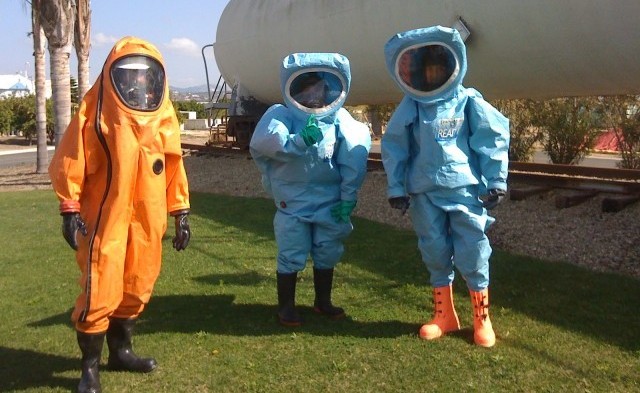
How many crime and trauma scene clean-up companies do you know of who wear Level A suits and SCBAs (Self-Contained Breathing Apparatus) like the ones in the photo below on a regular basis?
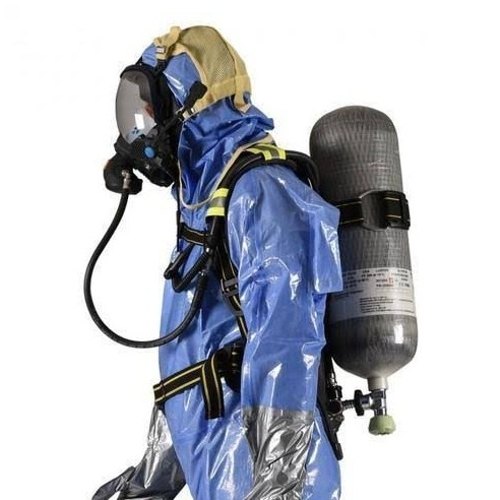
How many crime and trauma scene clean-up companies do you know of who wear Level B suits and SCBAs like the ones in the photo below on a regular basis?
Most personnel who clean-up after a suicide, homicide or unattended death at a residence, or business are not required to have HAZWOPER certification.
So, it is very clear:
If personnel who clean-up after a suicide, homicide or unattended death at a residence, or business ALSO perform emergency response to train derailments, airplane crashes, and industrial chemical warehouse fires, which do fall under the definition of an "uncontrolled hazardous waste site", then yes, they would be required to obtain HAZWOPER certification. They would need to have SCBAs and Level A and B suits (that can weigh 30-40 pounds each) and cost about $10,000.00 per worker. But they would already know this.
Look at this this way:
There are hazardous material technicians who work for environmental remediation contractors who also provide crime and trauma scene clean-up services. Those workers would need HAZWOPER certification. They already know that and already have HAZWOPER training.
The typical crime and trauma scene clean-up company that performs suicide, homicides or unattended death cleanups at a home and business would never need to be HAZWOPER certified because those scenes do not fall under 29 CFR 1910.120(a)(1).
It’s pretty simple. Most people who only perform clean-up after a suicide, homicide or unattended death at a residence or business will never need to be HAZWOPER certified. This is probably 99% of everyone in the crime and trauma scene clean-up industry. (This statement does not apply to companies that also perform drug lab remediation.)
Ask yourself this, “How many crime and trauma scene personnel keep Level A and Level B suits and SCBAs in their trucks?”
Those crime and trauma scene cleaners who want to get into more heavy-duty jobs involving chemical spills, train derailments, airplane crashes, etc., will need HAZWOPER and HAZMAT certifications. But it goes without saying that if they are qualified to clean-up after chemical spills, train derailments, and airplane crashes they will already have HAZWOPER and HAZMAT certifications.
I have trained thousands of crime and trauma scene personnel in 28 countries to date and have the following certifications:
- Certified Safety & Health Official (TEEX OSHA Training Institute Southwest Education Center)
- OSHA 501 Outreach Trainer (retired)
- OSHA Hazardous Materials
- OSHA Respiratory Protection
- Respirator Fit Test Administrator
- OSHA Confined Space
- OSHA 510
- OSHA 500
- OSHA Machine Guarding
- OSHA Electrical Standards
- Certified Drug Lab Decontamination-Worker (State of Washington)
- Certified Drug Lab Decontamination-Supervisor (State of Washington)
- Certified Asbestos Abatement Worker (Ontario, Canada)
- Certified Asbestos Abatement Supervisor (Ontario, Canada)
- Marijuana Grow Operations Remediation Supervisor
- 40-Hour HAZWOPER
- Certified Hazmat and Safety at Clandestine Drug Labs
- IICRC UFT–Upholstery & Fabric Cleaning Technician
- IICRC FSRT–Fire & Smoke Damage Restoration Technician
- IICRC OCT–Odor Control Technician
- IICRC HST–Health and Safety Technician
- IICRC CCT–Carpet Cleaning Technician
- IICRC MSR–Master Fire and Smoke Restorer
- Certified Anti-Terrorism (Weapons of Mass Destruction - Kenneth "Ken" Alibek, a former Soviet physician, microbiologist, and biological warfare expert was one of my instructors.)
As you can see from my credentials, I am a firm believer in ongoing education. I believe as professionals we should always endeavor to learn more. Do I think HAZWOPER is a good certification to have? Yes, I do, but I do not state that everyone who performs crime and trauma scene cleanup is required to have HAZWOPER certification.
Each employer must analyze the types of jobs they perform, the hazards involved, and if their work falls under the definition of an “uncontrolled hazardous waste site” or has the potential to become an “uncontrolled hazardous waste site;” if so, then they are required to have their employees be HAZWOPER certified.
I can see no situation where common crime and trauma scene would ever become a “uncontrolled hazardous waste site.” If the types of jobs performed do not fall under the definition of an “uncontrolled hazardous waste site” then employees do not have to be HAZWOPER certified.
The HAZWOPER certification decision is arrived at on a company-by-company basis. A very small minority of crime and trauma scene decontamination companies will need employee HAZWOPER certifications, but the great majority of the companies will not and never will. Therefore, the statement, you might hear or read, that that ALL personnel who perform crime and trauma scene remediation are required to be HAZWOPER certified is not true and accurate.
Do technicians need a HAZWOPER certification for Meth / Drugs Labs? Absolutely. But for common homicides, suicides, at homes and businesses? No, not at all.
Regards,
Michael J. Tillman
TEEX Certified Safety and Health Official and AMDECON® Founder
Frequently Asked Questions About HAZWOPER and Crime Scene Cleanup
Is a 40-Hour HAZWOPER required for crime scene cleanup?
No. According to OSHA Letters of Interpretation, a 40-Hour HAZWOPER certification is not required for typical or average crime and trauma scene cleanup, such as suicides, homicides, or unattended deaths. These scenes are considered "controlled" and do not meet the OSHA definition of an "uncontrolled hazardous waste site."
When is HAZWOPER training mandatory for biohazard remediators?
HAZWOPER training is mandatory if your work involves "uncontrolled hazardous waste sites" or emergency response operations. This includes cleanup of clandestine drug labs (Meth labs), train derailments involving hazardous substances, or industrial chemical warehouse fires where an uncontrolled release has occurred.
Which OSHA standards apply to crime scene cleanup if HAZWOPER doesn't?
Even if HAZWOPER is not required, employers must still comply with other relevant OSHA standards. These include 29 CFR 1910.1030 (Bloodborne Pathogens), 29 CFR 1910.132 (Personal Protective Equipment), 29 CFR 1910.134 (Respiratory Protection), and 29 CFR 1910.1200 (Hazard Communication).
Do I need HAZWOPER for unattended death cleanup at a private residence?
No. A private residence where an unattended death has occurred is not classified by OSHA as an uncontrolled hazardous waste site. Because the biological hazards are contained within the residence, it is a controlled scene, and 40-Hour HAZWOPER certification is not a legal requirement for the technicians performing the cleanup.
Is HAZWOPER certification required for Meth Lab cleanup?
Yes. Unlike standard crime scene cleanup, clandestine drug lab remediation involves hazardous chemicals and uncontrolled waste. OSHA and state regulations typically require HAZWOPER certification for any personnel involved in the decontamination of drug labs.